
Innovation Award 2026
Category criteria
- This category is open to individuals, teams or businesses making a big impact with an innovation.
- The innovation could be a new product, service or process or it could be an innovative use of an existing product, service or process.
- The judges will be keen to find out about the intellectual processes which gave rise to the design and development of the innovation.
- The judges will also want to know how innovation is handled within the culture of the company and will welcome nominations from businesses that have innovation at the core of their ethos.

Stafford Engineering Services Ltd
Innovation Award entrant
Stafford Engineering Services Ltd’s turnover has increased by nearly 160% over the last three years and its profits have increased by 581% during the same period.
Turnover for the coming year is expected to increase by a further 44% to £2.6 million.
Projects have included a £1.4 million agreement to supply more than 2,500 units to Queensland Ambulance Service in Australia.
Led by a brother and sister with a team of just 11 staff, the business has transformed from a small Midlands machine shop into an internationally recognised engineering innovator supplying ambulance services and medical manufacturers across Europe and Australia.
The company specialises in precision machining, fabrication and the innovative design and manufacture of medical device mounting systems for the emergency medical services sector.
Founded in 1994, the company initially focused on subcontract machining and fabrication work for regional manufacturers. A pivotal opportunity in 2004 led the business to diversify into specialist medical engineering solutions after West Midlands Ambulance Service identified a need for safer equipment handling within frontline emergency vehicles.
Responding directly to operational challenges faced by ambulance crews, Stafford Engineering Services designed and manufactured an innovative sliding tray system for defibrillators aimed at reducing manual handling injuries and improving accessibility in emergency situations. The success of this solution quickly attracted industry attention and resulted in collaboration with Zoll Medical UK to develop a completely new generation of medical device mounting brackets.
Working closely with frontline ambulance personnel and medical device manufacturers, the company combined practical engineering expertise with in-house design and manufacturing capability to create highly durable, user-focused mounting systems tailored specifically for the demanding emergency medical environment.
A key innovation was the development of an advanced mounting bracket capable of securely charging medical devices whilst in transit — solving a significant operational challenge for ambulance fleets and meeting critical European market requirements.
Successfully launched in 2018, this next-generation system significantly improved reliability, usability, and efficiency for emergency service providers and helped position the company as a market leader within the sector.
The company’s products are now installed across ambulance fleets including West Midlands Ambulance Service, South Central Ambulance Service, Welsh Ambulance Service and international emergency service operators.
Continuous innovation and product refinement have enabled Stafford Engineering Services to become a preferred supplier for Zoll Medical Europe, driving substantial export growth and expanding the company’s presence across global markets.
Innovation remains central to the company’s growth strategy. Profits have been continually reinvested into research and development, advanced manufacturing equipment and expanded production capability to support increasing global demand.
This commitment to innovation has enabled the business to compete successfully against much larger international manufacturers while remaining independently owned and UK-based.
Alongside product innovation, the company is also investing in the future of UK engineering by working with local colleges to develop apprenticeship opportunities and practical workplace training for young engineers. This commitment supports regional skills development while helping address engineering shortages within UK manufacturing.
Despite its growth and international reach, Stafford Engineering Services continues to maintain the values of a family-run business — prioritising quality, continuous improvement, customer collaboration, and long-term investment in both people and technology.

The Staffordshire Signal CIC
Innovation Award entrant
The Staffordshire Signal CIC is a non-profit, community-led media platform built to champion Staffordshire, support local businesses, strengthen community connection and tell the stories of people, places and organisations that may otherwise be overlooked.
The Signal brings together a free print magazine, digital features, newsletters, events coverage, business visibility, community stories and developing video work through The Staffordshire Signal TV.
The model is funded by local businesses and the community it serves through advertising, sponsorship, print subscriptions, reader support, partnerships and community backing. Because The Signal is a CIC, that support is reinvested into trusted local journalism, public interest storytelling, opportunities for young people and the long-term future of Staffordshire media.
This approach gives local businesses and organisations a trusted platform to reach local audiences. It helps residents discover events, places, stories and opportunities across the county. It provides positive, useful coverage for culture, heritage, hospitality, education, business, voluntary groups and community life.
The Signal recognises that not everyone has equal access to digital journalism. Digital poverty, low income, age, isolation, lack of confidence online or limited access to devices can all disconnect people from local news and information. A free, high-quality print magazine helps people in low-income areas, older residents, digitally excluded communities and those who feel disconnected from online platforms to access journalism rooted in where they live.
Founder Jenna Goodwin, also known as The Red Haired Stokie, built a trusted regional audience through local history, writing, photography, video and community storytelling before creating The Staffordshire Signal. That trust is central to the community impact. People engage with The Signal because it feels rooted in Staffordshire.
The Staffordshire Signal TV is the next stage of that community work. The video arm will tell Staffordshire’s stories through interviews, short films, documentaries, event coverage and community-led video content. It will also create opportunities for students and young people to gain real experience in writing, research, interviewing, photography, filming and editing.
The Signal is officially supported by key organisations across Staffordshire’s civic, business and education landscape including Staffordshire Chambers of Commerce, universities, councils, educational partners and place-making networks. Jenna is a We Are Staffordshire ambassador and represented Staffordshire at the House of Commons as part of a recent Staffordshire showcase.
The Staffordshire Signal CIC has entered the Skills for the Future, Business in the Community and Innovation Award categories of University of Staffordshire Business Awards.

Valentine Clays
Innovation Award entrant
Staffordshire-based Valentine Clays has created the UK’s first low-fire stoneware clay body, which means stoneware ceramics can be produced at lower temperatures with lower energy consumption and lower costs.
This development represents a major technical advancement in ceramics materials science and has been heralded as a clear example of how innovation can deliver both technical and real-world impact.
Traditionally, producing stoneware ceramics requires firing clay at very high temperatures, typically between 1200°C and 1300°C. This process consumes significant amounts of energy, increases costs and requires specialist kilns that are not accessible to all users. These limitations have historically restricted who can produce durable, high-quality ceramics.
Valentine Clays’ LoStone changes that. By combining the strength and durability of traditional stoneware with the lower firing temperatures more commonly associated with earthenware, Valentine Clays has developed a material that delivers professional-quality results using less energy and more accessible equipment.
LoStone directly addresses some of the sector’s most pressing challenges: sustainability, affordability and accessibility.
The scientific achievement behind LoStone lies in its formulation. Creating a clay that performs like stoneware at lower temperatures requires carefully balancing strength, workability and firing behaviour. This process involved extensive research, material testing and refinement to ensure consistent and reliable performance. The result is a technically robust solution that performs effectively across a range of studio and educational settings.
Valentine Clays is a UK-based clay manufacturer with a long-standing reputation for quality, consistency and technical expertise, having produced specialist clay for the ceramics industry since 1979.
With more than four decades of experience and international supply, the company has developed a deep understanding of the needs of makers, educators and institutions, supplying materials that support both traditional craftsmanship and contemporary ceramic practice.
Transforming a centuries-old process through modern materials science, this heritage provides a strong foundation for innovation and enables the business to respond effectively to the evolving demands of the sector.
Despite operating within a challenging economic climate, Valentine Clays has achieved consistent growth in both turnover and overall business development. This resilience has been driven by a clear focus on innovation and a commitment to solving real-world challenges faced by the industry.
Valentine Clays has entered the Innovation Award category of University of Staffordshire Business Awards.

Power SOS
Innovation Award entrant
The brainchild of University of Staffordshire alumnus Steve Holmes, Power SOS is believed to be the first mobile app of its kind in the world.
Alongside long-established and thriving sister company Midlands Power Networks, Power SOS will help to restore power to critical services such as hospitals and prisons as well as the likes of retail, manufacturing, football stadiums and universities when it launches this year.
Steve, the managing director of Stoke-on-Trent based Midlands Power Networks, had the idea for a high voltage response emergency app and has worked with University of Staffordshire students to make it a reality.
Power SOS now has a team of five employees, mostly sourced from University of Staffordshire through a Knowledge Transfer Partnership and Unitemps, and is projected to go from a standing start to a significant annual turnover when it launches in the third quarter of the year.
The app holds each customer’s asset register and records and not only provides information as to possible causes but also highlights to any attending engineers any specific risks on that site ensuring they are well informed before arriving on site and HSE compliant. Not only will this minimise downtime it also reduces the risk for environmental impact and insurance claims.
Combining several cutting-edge technologies, AI to not only assist the customer in identifying their emergency but also the engineer in resolution; new location tracking, as yet not available in the world except within this app, and even predictive analysis to help prevent failures before they happen.
The app will record attendances and their outcomes and customers will be able to leave reviews.
Power SOS has entered the Start-up Business of the Year and Innovation Award categories of University of Staffordshire Business Awards.

The Student Safety App
Innovation Award entrant
The Student Safety App is a free, crowdsourced platform designed specifically for students, enabling them to report a wide range of concerns, from suspicious activity to safeguarding concerns.
The concept was born after the tragic Nottingham attacks in June 2023 when Monica Ghuman, then a student at Nottingham Trent University, witnessed first-hand the impact on the student community, the city and ultimately the nation. It highlighted how outdated, fragmented and slow current reporting systems can be, with long response times and interfaces that fail to meet the expectations of today’s digital learners.
Monica came up with the idea for the Student Safety App, helped to attract investment and now works as Project Lead as part of a team of 10 people including both part-time and full-time staff.
She said: “It’s nice to hear that people believe the Student Safety App is something that we have been missing. It means a lot to see this come to life.”
The app has already delivered significant impact across colleges, universities, charities and accommodation providers, with more than 50,000 students using the platform and numbers rising daily.
Feedback shows that SSA has helped streamline safeguarding workflows and centralise communication, allowing teams to respond more quickly to concerns. Students report feeling more confident when reporting through the app, as it feels more discreet and natural than traditional forms.
Within universities, the platform has supported earlier identification of incidents such as suspected spiking and violent behaviour. With personal follow-ups from the head office team, many students have felt comfortable engaging with investigations, supporting police enquiries and driving positive change within venues where appropriate.
SSA has also achieved strong national visibility, with the launch campaign generating more than 9.12 million impressions and coverage on major outlets, including BBC News and ITV News Central. Monica’s interviews on BBC Radio Nottingham and ITV Central have further strengthened awareness.
Partnerships, particularly with Student Roost, have increased credibility and demonstrated the value of the platform within the national accommodation sector, inspiring uptake from other big, influential corporations.
Monica has entered The Student Safety App into the Innovation Award category of the University of Staffordshire Business Awards.
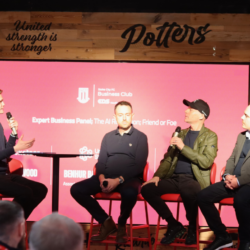
Rocketeer Orbit
Innovation Award entrant
Rocketeer Orbit is a business growth consultancy that combines AI with human consultants to help Staffordshire businesses take flight.
Set up in Stafford by former teacher Richard Wood, it now has six human employees and six AI agents. Clients range from a business with a £25,000 annual turnover to a £200million company.
CEO Richard Wood’s diverse work background includes primary and special needs teaching, teaching ex-offenders and running a film studio before founding Rocketeer Enterprise, which has now become Rocketeer Orbit.
As an AI growth consultant he helps established business owners and education leaders in Staffordshire and beyond to cut through the noise around AI.
Richard and his team aim to demystify AI, creating clear, practical strategies that unlock potential, activate significant growth and drive real, quantifiable business value.
Services include AI audits to deep delve into organisations to find the highest impact opportunities for AI integration, strategic one-to-one consultation to build a robust and safe AI adoption roadmap and workshops for teams and organisations looking to understand the AI landscape.
The service is delivered by a combination of human staff and the Rockateer AI platform which has been created to help businesses gain clarity on the value of the business and to track its growth in real time.
Richard and his team often deliver their work through local authorities and business organisations so that they can support multiple businesses simultaneously, but also offer their services to individual businesses. He is also often called on to be a keynote speaker on AI.
“This is about helping businesses to stay focussed on growth but also to recognise that growth isn’t an art, it’s a science. We can help them to understand that science.
“If a business understands what it’s trying to do and where it’s trying to get to then AI can definitely help because it’s just a tool. The starting point is clarity about what they’re trying to do.
“We’re still very human focussed. What we’re developing is an eco-system of business growth including networking events and bringing in potential investors.”
The business is currently run from the Shire Hall Business Centre in Stafford. Richard has plans to start networks in Birmingham, Manchester and London and is then looking to make the business international.
Rocketeer Orbit has entered the Innovation Award category of University of Staffordshire Business Awards.

NeuroTalks
Innovation Award entrant
University of Staffordshire alumna Jodie Steele has created three brands inspired by her own experiences with neurodiversity.
The 44-year-old, from Stone, graduated in Marketing in 2003 and went on to work in high-pressure sales and marketing roles for multinational businesses including five years working overseas. She has worked for newspaper groups and in both radio and television.
During the pandemic she had a neurological crash which caused problems with her vision and a loss of motor skills on the right side of her body. She also had a late diagnosis of ADHD.
Jodie has spent several years rehabilitating during which the marketeer in her realised that her own lived experience was the basis of a brand that could help other people. That brand is also now becoming an income stream for Jodie.
She founded NeuroTalks, a lived experience led training and consultancy business that supports organisations to build neuro-inclusive, high-performing and psychologically safe environments.
A growing suite of digital products have been developed including free and paid workbooks, training resources and recorded content.
Alongside Neurotalks she has developed complementary ventures Alchemy Souls Travel, an inclusive and wellbeing-led travel storytelling brand, and Aura & Ash, a sustainability-focused lifestyle brand.
All three brands are gaining increased social media interaction. Jodie has been doing paid work through her brands since November including collaborations with the likes of the RSPCA.
Jodie said: “This could have broken a lot of people but if I can use it to help other people then I think that’s a really positive thing and it motivates me to do more.”
Jodie has entered the Alumni Business Person of the Year category of the University of Staffordshire Business Awards and has entered NeuroTalks into the Innovation, Skills For The Future and Business in the Community categories.
She added: “I’m a graduate of University of Staffordshire and this is not simply a historical detail; it is part of my identity as a business leader. The value of that learning, real-world relevance and community connection continue to influence how I operate today.
“I represent the kind of graduate who builds impact over time and offers sustained contribution; not a single business, but an ecosystem; not profit at the expense of people, but performance through inclusion.
“To be recognised as Alumni Business Person of the Year would not only reflect my own journey but would shine a light on the importance of neuro-inclusive leadership, wellbeing-led innovation and values-driven entrepreneurship - areas that increasingly define future work, travel and community life.”
Hixon Group
Innovation Award entrant
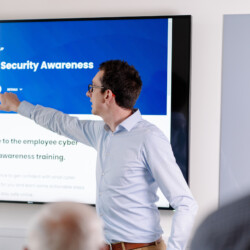
Hixon Group has developed an innovative and scalable approach to tackling one of the most significant challenges facing UK businesses - the vulnerability of small and medium-sized organisations to cyber threats.
Based at Keele Science Park, the IT and cybersecurity provider is behind the Staffordshire Cyber Resilience Programme, a free-to-access digital platform designed to help businesses understand, assess and improve their cybersecurity in a clear, practical and accessible way.
The programme was created through a partnership with Keele University and Staffordshire Chambers of Commerce, supported by Newcastle-under-Lyme Borough Council. This collaboration brings together academic research, real-world threat intelligence and direct access to the regional business community.
The innovation was driven by a clear and urgent problem. While cyber-attacks increasingly target SMEs, most lack the resources, knowledge or confidence to respond. Hixon Group identified that the issue was not just technical, but human.
Many business owners face what the programme defines as the ‘embarrassment barrier’ - a reluctance to engage with cybersecurity due to fear of not understanding it. This insight became central to the design of the solution.
Rather than developing another technical training product, Hixon Group helped create a system that translates cybersecurity into simple, relatable actions. This is delivered through the Digital Fortress framework, which reframes complex concepts into everyday language, helping non-technical users understand and take control of their risk.
The platform combines short, accessible learning modules with a Cyber Maturity Diagnostic tool. Users answer simple, plain-English questions and receive a clear, personalised risk profile, alongside practical steps they can immediately implement.
Since launch, the programme has engaged more than 5,000 users within six months. Data shows a significant increase in the adoption of key security measures, including multi-factor authentication, alongside improved user confidence and awareness.
Participating organisations have reported a reduction in cyber incidents of up to 60%, with economic modelling suggesting the programme has already prevented substantial financial losses for local businesses.
Hixon Group was founded in 2011 by Managing Director Jonathan Lawton. He now has a team of three staff which will grow to four people in September.
Jonathan Lawton has entered the Entrepreneur of the Year category of University of Staffordshire Business Awards and has entered Hixon Group into the Innovation Award category.

Desire Cocktail Bar
Innovation Award nomination
Dereece Gardner opened Desire Cocktail Bar in Stoke-on-Trent City Centre in December 2023 with the aim of elevating the area’s drinking culture. Less than three years later he’s achieved national acclaim.
The former area manager for PureGym invested £100,000 to open the venue in Piccadilly, Hanley and has already won a string of awards.
Desire has been awarded gold and silver accolades in the Staffordshire and Stoke-on-Trent Tourism Awards, was a finalist in the Midlands Food, Drink and Hospitality Awards and Dereece has been invited to join the judging panel for the prestigious Bartenders Brand Awards 2026.
Desire has been featured in Class Bar Magazine, on BBC Radio and has entered into partnerships with the likes of Land Rover.
In 2025 he launched the Staffordshire Drinks Collective, an industry-led initiative designed to bring together hospitality professionals, producers, suppliers and enthusiasts from across the county to raise the profile of Staffordshire’s drinks and hospitality sector.
Dereece has been nominated for the University of Staffordshire Business Awards by members of the Desire Collective, a membership community he set up to reward loyal customers.
Desire Collective member Chelsea Cope said: “These achievements reflect not only commercial success but also a genuine commitment to strengthening the hospitality industry at both a local and regional level. Through innovation, collaboration and a passion for developing others, Dereece continues to make a lasting contribution to Staffordshire’s business community and the wider drinks sector.”
Dereece Gardner has been nominated in the Entrepreneur of the Year category and Desire Cocktail Bar has been nominated in the Innovation Award category.

iZero
Innovation Award entrant
What started as a solution to one company’s staffing problems is now becoming a technology platform with the potential to transform workforce management across the hospitality, events and sports industries.
Developed by entrepreneur Craig Wilkinson who has a portfolio of businesses, iZERO was created to solve the real-world operational challenges faced by one of his companies, Coalition. The global business is a temporary staffing agency that manages teams for major events across the UK and internationally, including brands such as Google, Nvidia, Amazon, NFL, NBA.
Handling large temporary workforces across multiple venues, events and time zones exposed major weaknesses in traditional staffing systems. Existing software was often expensive, overly complicated or unable to cope with the fast-moving demands of temporary staffing, payroll and live event management.
Rather than accept inefficient systems, Craig invested in building a tech platform. As Craig’s business portfolio grew beyond event staffing, he continued to reinvest into the system, evolving beyond temporary staffing to full workforce management.
The result was iZERO, an all-in-one workforce management platform designed to simplify and streamline the way businesses manage staff. The platform handles onboarding, payroll, contracts, rotas, timesheets, workforce communication and clocking in and out through a QR-code based system that works across both full-time and temporary staff.
iZERO was not developed as a theoretical tech concept. It was built from direct operational experience, tested in live business environments and refined over five years through day-to-day use within Coalition’s global operations.
The platform already manages large workforces and processed more than £600,000 of staff payroll in 2025. It supports the coordination of hundreds of staff working across different sectors and helps reduce administration time, improve communication and increase operational efficiency.
After five years of successful in-house use iZERO is now preparing for commercial launch, with a newly developed mobile app helping expand its capabilities even further. The business is already in discussions with several football clubs and other organisations interested in adopting the platform, including working with Port Vale in 2025 to trial the system.
This next phase represents a major opportunity for a Staffordshire-developed innovation to scale nationally and internationally.
At its heart, iZERO demonstrates how innovation often comes from understanding problems first-hand. Craig Wilkinson identified a challenge within his own business, developed a solution tailored to real operational needs and created a platform with the potential to benefit businesses far beyond his own organisation.
By combining technology with practical business experience, iZERO has evolved from an internal management tool into a scalable innovation capable of transforming how companies manage their workforce. 2026 is where iZero now begins its journey as a Staffordshire based Software as a Service (SAAS) business.
iZero has entered the Innovation Award category of University of Staffordshire Business Awards.

Pinc College
Innovation Award entrant
Traditional educational environments can fail to meet the needs of neurodivergent young people. Rather than attempting to retrofit existing systems, Pinc College has built an innovative model, one that integrates specialist education with the UK’s rich cultural and heritage infrastructure.
Pinc College is an independent specialist college supporting neurodivergent 16 to 24-year-olds through highly personalised, project-based study programmes. Pinc’s campuses are all placed within cultural, artistic and heritage settings, transforming these spaces into inclusive learning environments.
Over the past decade, Pinc has refined a methodology that combines creative curricula, individualised support and inspiring environments. With 19 campuses across England and Wales, located in galleries, museums, woodlands and historic sites, Pinc has demonstrated that place-based learning can unlock engagement and progression for students who have often been excluded from mainstream education.
In Staffordshire, this innovation is being realised through the adaptive reuse of significant heritage buildings in the area. Pinc College’s existing campus at Middleport Pottery demonstrates how historic industrial spaces can be reimagined as dynamic centres of learning. The character of the building provides inspiration and a sense of identity, allowing students to connect with place, history and creativity in a way that conventional classrooms cannot replicate.
Building on this success, Pinc College is making the short but exciting move into new premises at the iconic 200-year-old Bethesda Chapel in Hanley. This move represents a step-change in how heritage assets can be activated for contemporary social impact.
The redevelopment of Bethesda Chapel demonstrates how culturally significant spaces can be sensitively repurposed to meet urgent societal needs. In this case, improving educational outcomes for neurodivergent young people. This approach not only safeguards the building’s future but enhances its relevance to the community.
Pinc has created a unique model that connects further education with cultural institutions and heritage sites. By situating learning within these spaces, students gain access to enriching environments that stimulate creativity and curiosity. At the same time, cultural organisations benefit from increased accessibility and engagement with new audiences. This mutually beneficial relationship represents a new paradigm for cross-sector collaboration.
Unlike traditional education providers that adapt existing systems, Pinc’s model is intentionally designed around the needs of neurodivergent learners. Every student follows an Individual Learning Plan tailored to their strengths, interests and aspirations. Their curriculum focuses on the Arts, and in particular level 2 and 3 Art & Design Diplomas, Functional Skills, and developing Maths and English. Programmes are project-based, enabling students to explore topics they are passionate about while developing transferable skills.
The physical environment plays a crucial role. Spaces are chosen and adapted to reduce barriers, foster wellbeing and encourage self-expression.
Pinc’s approach improves attendance as well as grades and all their students progress into supported internships, employment, further or higher education or other positive destinations.
Rachel Newman, Chief Impact and Compliance Officer for Pinc College, said: “Ultimately, Pinc College’s work in Staffordshire exemplifies innovation that is both practical and transformative. Innovation does not always require new construction or technology; sometimes it lies in seeing existing assets differently and unlocking their potential for new purposes.
“The redevelopment of Bethesda Chapel is more than a building project, it is a statement about the future of education, inclusion and community.
“Pinc College is not just delivering education, it is reshaping systems, redefining spaces and creating opportunities where they did not previously exist. This is innovation with lasting impact, both for individuals and for the communities they are part of.”
Pinc College has entered the Innovation Award and Business in the Community categories of University of Staffordshire Business Awards.

Wavemaker Stoke CIC
Innovation Award entrant
Wavemaker Stoke CIC was set up to bridge the digital divide and ensure that people across Stoke-on-Trent are not left behind in an increasingly digital world.
Since 2015 it has worked at the intersection of community, technology, education and social impact, helping residents gain the digital access, confidence and skills they need for everyday life, employment, health, wellbeing and future opportunity.
The CIC was set up by co-founders and directors Alex Rowley, who was born and bred in Stoke-on-Trent, and University of Staffordshire alumni Ben McManus.
Over the last two years, through the UKSPF-funded DigitAll programme, Wavemaker has delivered a city-wide digital inclusion model across Stoke-on-Trent, designed to reach people who are often furthest from opportunity.
This has included economically inactive residents, job seekers, older adults, people experiencing social isolation, families, school pupils, community volunteers and those facing barriers linked to poverty, confidence, health, disability or lack of access to technology.
Wavemaker has built a strong local delivery ecosystem, working with 45 partner organisations and establishing 20 hyper-local digital hubs across community settings such as foodbanks, family hubs, employment centres and trusted local venues.
These hubs bring support into the places people already know and trust, rather than expecting residents to find their way into formal training environments. This approach has helped create a welcoming, accessible and community-led model of support.
In the last two years Wavemaker has distributed 571 laptops to economically inactive residents, delivered 408 face-to-face digital skills sessions and trained 2,298 adults. Each laptop, session and learner represents someone gaining the ability to apply for work, manage appointments, access services, stay connected, learn new skills or take greater control of their life.
Wavemaker CIC has entered the Skills for the Future, Team of the Year, Innovation, Business in the Community and Small Business of the Year categories of University of Staffordshire Business Awards.

Ellina Pollitt
Innovation Award entrant
What began as a solo project for Ellina Pollitt during her time as a student at University of Staffordshire has turned into a multi-award-winning, internationally-recognised jewellery brand.
Ellina, who co-designed the University’s mace, has had her designs featured in glossy, lifestyle magazines in the UK and overseas, including in Vogue.
Originally from Russia and now living in Biddulph, Ellina has exhibited nationally and internationally at prestigious events including Munich Jewellery Week, Goldsmiths Fair, Goldsmiths North, Cluster Contemporary Jewellery Fair in London, and New York Jewellery Week. She has represented both Staffordshire and University of Staffordshire on an international platform, showcasing innovative British design to audiences across Europe and the United States.
Her work has received significant industry recognition. She was awarded a Gold Award from the Goldsmiths’ Craft and Design Council for Laser Technologies and received the overall Alfa Laser Award. She was shortlisted as a finalist for Rising Star of the Year at the National Association of Jewellers Awards and received the Luminary Award in New York for wearable art.
Ellina blends traditional jewellery-making techniques with cutting-edge technologies such as fibre laser cutting and powder coating.
She joined University of Staffordshire in 2016 for a foundation year followed by a BA (Hons) in 3D Design (Jewellery) which she completed with First-Class Honours. She later returned to join the Peter Coates MSc in Entrepreneurship, which supported the development of her business.
She is a strong advocate of the transformational power of education and says she owes much of her current success to the support she has received during her time at University of Staffordshire.
She said: “Alongside building my business, I have actively contributed to education and community engagement across Staffordshire. During the past year I have delivered jewellery workshops, creative sessions and educational talks for students and community groups, sharing both practical jewellery-making skills and entrepreneurial knowledge.
“Working with Stoke-on-Trent College and local arts organisations has allowed me to inspire future creatives while demonstrating how art, design and business can work together to create career opportunities.
“The growth of my business has also been supported through strategic collaborations with photographers, fashion creatives, galleries and international exhibition organisers.
“One of the achievements I am most proud of is establishing my own jewellery workshop after completing my studies. This has enabled me to continue developing collections, teaching workshops and creating new opportunities for business growth. Through determination and innovation, I have transformed a passion for jewellery design into a sustainable business with international reach.
“My journey has not been without challenges. As a mature student, single mother and entrepreneur, I have balanced education, family responsibilities and business development simultaneously. Building a creative business while completing two degrees required resilience, commitment and continuous learning.
“The support I received from mentors, lecturers and the wider University community played a significant role in helping me overcome obstacles and continue progressing professionally.
“University of Staffordshire has remained an important part of my journey, and I am proud to continue representing the institution through my achievements and business activities. My story demonstrates how education, creativity and entrepreneurship can create meaningful opportunities, not only for individual success but also for contributing to the wider creative economy.
“Looking ahead, my ambition is to continue expanding internationally, collaborate with fashion designers and luxury brands, develop educational opportunities for emerging creatives, and further establish Staffordshire as a region recognised for innovation and contemporary design.”
Ellina Pollitt has entered the Alumni Business Person of the Year, Growth, Entrepreneur of the Year and Innovation categories of University of Staffordshire Business Awards.

Currie Young
Innovation Award entrant
Currie Young Insolvency & Restructuring is redefining what innovation looks like within a traditionally conservative professional services sector, helped by a collaboration with University of Staffordshire.
The business has offices in Manchester, Lichfield and Halesowen alongside its head office in Campbell Road, Stoke.
Operating within the advisory, restructuring and business support environment, it recognised early that the profession was facing increasing operational pressures. Rising regulatory demands, growing client expectations, recruitment challenges and significant administrative burden were placing strain on traditional operating models, many of which still relied heavily on manual processes and legacy systems.
At the same time, businesses increasingly expected professional advisors to be more responsive, commercially agile and technologically capable, without losing the reassurance and expertise that come from experienced human advisors.
Rather than viewing innovation as a standalone technology exercise, Currie Young approached it as a long-term business strategy focused on modernising service delivery, improving operational efficiency, scalability and future-proofing the business for sustainable growth.
Central to this journey has been a collaborative relationship with University of Staffordshire through a Knowledge Transfer Partnership, enabling the business to combine industry expertise with academic research, digital capability and innovation-led thinking in a way that remains relatively uncommon within the wider professional services sector.
Currie Young wanted to address the genuine operational challenge of highly skilled professionals spending disproportionate amounts of time on repetitive administration, duplicated data entry and fragmented information gathering, reducing efficiency and the time available for strategic advisory work and client relationships.
Through analysing internal workflows and operational bottlenecks, it identified onboarding and information capture as one of the most resource-intensive stages within the client engagement process. Historically, the collection, organisation and processing of information had remained largely manual despite growing demands for speed, accuracy and transparency.
Working collaboratively with the University, it developed a bespoke digital First Day Information onboarding and information management system designed around the practical realities of complex professional service workflows.
The resulting platform automates aspects of document collection, workflow preparation and data structuring, creating a more streamlined and scalable operational model while improving collaboration and responsiveness across the business.
The impact of the innovation has already been significant. By modernising onboarding and workflow processes, Currie Young has materially reduced administrative burden, improved consistency across case handling and enhanced operational responsiveness. Teams are able to access and process information more efficiently, collaborate more effectively and dedicate greater time to strategic and advisory work.
Currie Young Insolvency & Restructuring has entered the Innovation, Business in the Community and Small Business of the Year categories of University of Staffordshire Business Awards.